
EXPLORE YOUR ELECTRICITY
From the supply.
Into your home.
Understand the equipment, who looks after it and when to bring in an electrician.
One continuous film · Jump to a chapter
LESSON 1 · THE SUPPLY TO YOUR HOME
Follow electricity into your home.
Follow the pencil from the incoming supply through the meter cabinet, electricity meter, tails and isolator. Understand each component, where the home’s installation begins and when to hire an electrician.
Continue exploring electricity
Read the transcript
Incoming cable · 0:00
Welcome to the home of EPHG. Let’s follow electricity into this house, one part at a time.
The electricity service cable connects this home to the local distribution network. This house has an underground supply; other homes have overhead wires.
As the cable reaches the wall, it ends at a service head, also called a cut-out.
Service head and main fuse · 0:36
This enclosure houses the main fuse, before the electricity meter.
The fuse normally sits inside its sealed holder.
Inside the fuse is a metal element.
If excessive current flows long enough, this element melts. This breaks the circuit to limit damage. Unlike a trip switch, this main fuse cannot be reset.
The incoming service cable, service head and main fuse are normally maintained by your local network operator. Your energy supplier is the company that bills you.
Sealed equipment needs authorised work. Do not break the seals or remove the fuse yourself; your electrician can coordinate the correct arrangements.
Switching off your home’s main switch does not make this incoming equipment safe. Leave it closed.
If you notice damage, scorching or a burning smell at the incoming cable or service head, keep away. Do not touch the equipment or attempt a repair. Contact your network operator using the numbers shown.
On screen: network emergencies — 105 in Great Britain; NIE Networks: 03457 643 643 in Northern Ireland.
Planning a heat pump or electric vehicle charger? Ask your installer to assess the supply and coordinate any required network approval or upgrade.
Electricity meter · 2:15
After the main fuse, the electricity meter records energy taken from the network in kilowatt-hours.
One kilowatt-hour is one kilowatt used for one hour.
The reading is a running total. The increase between two readings tells you how much energy was taken from the network during that period.
On-screen example: an earlier reading of 1,234 kWh and a later reading of 1,237 kWh show 3 kWh imported from the network.
Your supplier uses those readings and your tariff to calculate the energy charge.
On-screen note: any standing charge is separate from the energy charge.
A smart meter can send readings automatically. Its indoor display is a separate device.
In Great Britain, contact your energy supplier for meter faults, reading concerns, or to arrange metering work.
In Northern Ireland, NIE Networks owns and manages the main electricity meters. Billing and tariff questions go to your supplier.
Meter tails and isolator · 3:22
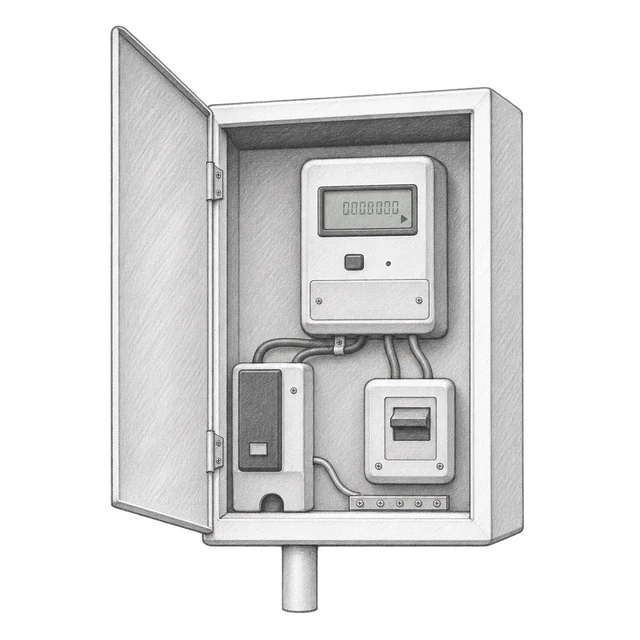
The meter cabinet and its door protect this equipment. They are normally the property owner’s responsibility, even though the sealed equipment inside has different owners.
The cables leaving the meter are called meter tails. They carry the supply towards the consumer unit, where it is divided into the home’s circuits.
On-screen note: meter tails are insulated and sheathed cables.
Some homes have a separate isolator between the meter and consumer unit. This double-pole switch disconnects both line and neutral from the installation beyond it.
On-screen note: the isolator is a switch, not automatic fault protection.
The incoming side can still be live. Solar panels or batteries can introduce other sources of electricity.
The cables leaving this isolator towards the consumer unit form part of the property owner’s installation. Without a separate isolator, the owner’s supply cables normally run directly from the meter.
Responsibility for the isolator itself and the short meter connections can vary. Your electrician and energy supplier should confirm the arrangement before work begins.
For faults, repairs or alterations to the consumer unit, its supply cables or the wiring inside your home, hire a qualified electrician. They can assess the work and coordinate any necessary supply isolation.
On-screen note: renters should contact their landlord or managing agent about the property’s installation.
Our next film will follow the supply from the consumer unit into the home’s circuits. Find the series through Explore your electricity.
Sources and supply arrangements
This film shows one typical underground household supply. Other homes have overhead or shared supplies. The route and depth are illustrative, not a guide to locating or installing a cable.
The separate fuse illustration explains the principle. The installed service head stays closed; this is not a demonstration of opening it or removing a fuse. Responsibilities and authorisation arrangements vary locally. No fuse rating or supply capacity is assumed for your property.
The digital meter and its reading are illustrative. The cabinet is introduced in the final chapter after the individual devices have been explained. The film describes a main import meter; private submeters, export registers and multi-rate tariffs may need additional readings. In Great Britain, your supplier arranges metering work; that does not mean the supplier always owns the meter. Northern Ireland has different metering arrangements.
The final chapter shows an example with a separate double-pole isolator. Some homes do not have one. The isolator’s ownership and the short meter connections vary; confirm the actual arrangement before work. The outgoing cables towards the consumer unit, consumer unit and home circuits form the property’s installation. Renters should contact their landlord or managing agent. Equipment remains closed throughout; this is an explanation, not wiring or isolation instructions.
The 3D example retains a 140 × 220 × 65 mm meter inside a 410 × 595 × 220 mm surface cabinet, with an isolator based on a 50 × 145 × 78.5 mm enclosure. These proportions support the illustration; they are not an installation specification or proof of approval for a particular property.
- SSEN: service cable and main fuse responsibilities
- UK Power Networks: the cut-out and main fuse
- UK Power Networks: assessing a fuse upgrade
- Eaton: how fuses operate
- IET Wiring Matters: removing the distributor’s cut-out fuse — guidance for electrical professionals.
- Energy Networks Association: electrical safety guidance (PDF) — incoming equipment and regional emergency contacts.
- British Gas: kilowatts and kilowatt-hours
- Office for Product Safety and Standards: meter readings, accuracy and supplier contact — Great Britain.
- Ofgem: smart meters and indoor displays
- Ofgem: unit rates and standing charges
- Consumer Council: bills and metering in Northern Ireland
- UK Power Networks: who arranges a new meter
- National Grid: isolation switches
- UK Power Networks: meter cabinet and customer responsibilities
- Prysmian: meter tails
- Timloc: surface cabinet dimensions (PDF)
- Hager: meter-box isolator dimensions (PDF)
WHEN YOU NEED AN ELECTRICIAN
Understanding can lead
to the right help.
Tell us what is happening at your property. We’ll explain our electrical service, check availability for your location and discuss the charges before a booking.