
EXPLORE YOUR GAS SYSTEM
From the gas network.
Into your home.
Understand the equipment, who looks after it and when to bring in a Gas Safe registered engineer.
This film follows a typical mains natural gas supply. LPG installations have different arrangements.
One continuous gas supply film · Jump to a chapter
LESSON 1 · THE GAS SUPPLY TO YOUR HOME
Follow gas into your home.
Follow the pencil from the gas main through the service pipe, meter box, emergency control valve, regulator and meter. Understand responsibilities and when to contact the network, supplier or a Gas Safe registered engineer.
Continue exploring your gas system
Read the transcript
Main & service · 0:00
Welcome to the home of EPHG. This house uses mains natural gas. Let’s follow its journey from the street to the pipework serving the home.
The gas main distributes gas through the local network. The network operator maintains these pipes. This is a different role from the energy supplier that sells you gas and sends your bills.
A smaller service pipe connects the main to the property. In this example, a yellow plastic pipe runs below ground and meets a protected metal riser. Pipe materials, routes and depths vary between properties.
Meter box & valve · 0:46
The external meter box protects the equipment and provides access to it. The box itself is normally the property owner’s responsibility, even though the gas equipment inside is looked after separately.
The emergency control valve allows the incoming gas supply to be shut off. Know where yours is before an emergency. In the usual Great Britain arrangement, the network operator maintains the service pipe up to and including this valve.
Regulator · 1:20
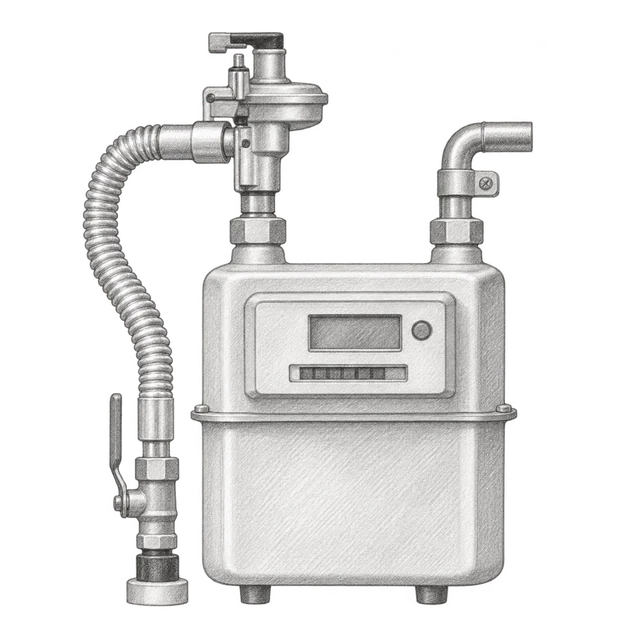
The regulator controls the pressure of gas passing through the meter. It helps keep that pressure within the range the installation needs. Its settings are sealed; adjustment and repair belong with authorised specialists.
Gas meter · 1:38
The gas meter records the volume passing through it. This metric example reads in cubic metres; older meters may use cubic feet. Your bill converts the reading into kilowatt hours, which measure energy.
In Great Britain, your supplier normally arranges care of the meter and its associated equipment. In Northern Ireland, the network may look after the meter too. For reading or billing questions, start with your supplier.
Your pipework · 2:14
From the meter outlet, the pipework feeding the home’s appliances is normally the property owner’s responsibility. Here it is shown in copper, but materials vary. Owning that pipework does not make it suitable for do-it-yourself gas work.
For repairs or alterations to the home’s gas pipework and appliances, use a Gas Safe registered engineer qualified for that work. Check their registration and the categories on their identification card. If you rent, contact your landlord or managing agent.
Gas emergency · 2:55
If you smell gas, avoid flames and electrical switches. Leave the building and call from outside. In Great Britain, call 0800 111 999. In Northern Ireland, call 0800 002 001. Follow the emergency service’s advice.
The next film will follow the pipework beyond the meter towards the appliances it serves. Find the series through Explore your gas system.
Sources and supply arrangements
This example follows a mains natural gas supply, not LPG. It continues the same 3D house, retaining its electricity and water installations. Routes, depths, component sizes and positions illustrate the explanation; they are not installation instructions.
In the usual Great Britain arrangement, network responsibility includes the service pipe and emergency control valve. Your supplier normally arranges care of the metering equipment. That does not mean the supplier necessarily owns every component. In Northern Ireland, the network may look after the meter too. Confirm unusual or shared arrangements with the relevant network and supplier.
The meter box and pipework after the meter are normally the property owner’s responsibility. For work on the home’s gas pipework and appliances, use a Gas Safe registered engineer qualified for the fuel, appliance and work concerned. The film shows the exterior of the components; it does not demonstrate operating the valve, unsealing equipment, adjusting pressure or carrying out repairs.
The coloured-pencil passes represent example materials: yellow polyethylene below ground, a protected riser above ground, and copper installation pipework. Materials vary. Colour alone does not establish ownership or reliably identify a pipe’s contents.
If you smell gas, avoid flames and electrical switches, leave the building and call from outside. Great Britain: 0800 111 999. Northern Ireland: 0800 002 001. Follow the emergency service’s advice.
- Energy Networks Association: Typical Great Britain network/ECV, supplier/meter equipment and customer outlet/box responsibility; exposed PE caution.
- HSE: Emergency controls, pressure regulator function and sealed settings; no demonstration of adjustment.
- Office for Product Safety and Standards: Meter volume in cubic metres or cubic feet; energy bill conversion into kilowatt hours; supplier handles billing queries.
- HSE: Check engineer registration.
- HSE: Engineer ID card work qualifications and landlord/agent maintenance arrangements.
- Phoenix Energy: Northern Ireland meter apparatus distinct from owner-maintained housing.
- firmus energy: Northern Ireland network-side meter apparatus maintenance and customer-side pipework responsibilities.
- Gas Safe Register: Great Britain0800111999; Northern Ireland0800002001, emergency gas response.
- OVO Energy: Gas emergency: avoid electrical switches, wait outside and call emergency service.
- Evolve network: Northern Ireland emergency number0800002001 and immediate response.
- Radius Systems: Example yellow polyethylene gas service pipe.
- SGN: Service pipe from main to ECV outlet; use of polyethylene and/or steel.
REPAIRS AND PLANNED WORK
Find the right help
for your gas appliances.
Once an emergency has been made safe, repairs may need a Gas Safe registered engineer qualified for the appliance and fuel. EPHG can discuss gas boiler repair services, availability and charges before a booking.