When Faulty Products Cost the Trade: Why Installers Need to Price for Risk
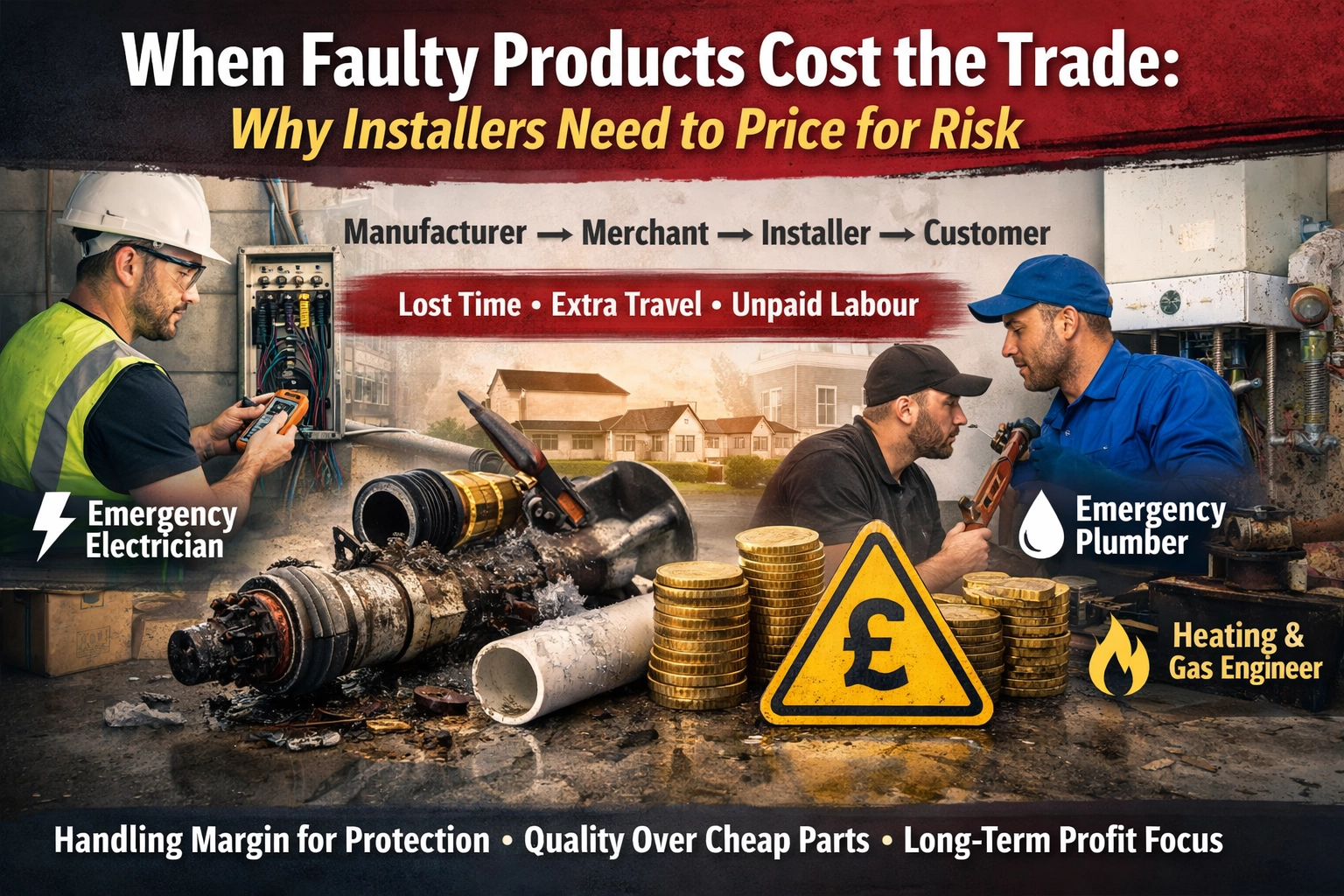
Faulty products are a real cost to the trade. Whether you work as an Emergency Electrician, Emergency Plumber, Emergency Heating Engineer or Emergency Gas Engineer, one early product failure can turn a decent job into unpaid labour, wasted travel and lost earnings.
At EPHG Limited, we think this issue is often talked about with a lot of frustration but not enough structure. The frustration is justified, but the smarter conversation is about how installers protect themselves while still delivering a fair and professional service to customers.
If you want to explore more electrical articles, plumbing articles, heating articles and gas articles, our Explore section covers a wide range of real-world trade topics and service-related guidance.
The Merchant Is Usually Not the Root of the Problem
When a product fails, many installers understandably look at the merchant first because that is where the purchase was made. In reality, that is often pointing the blame in the wrong direction. Most merchants are supplied by the same manufacturers, and unless someone is fitting obvious knock-offs or very poor-quality copies, the problem normally begins at manufacturing level.
The chain is simple:
Manufacturer → Merchant → Installer → Customer
The merchant may be the point of sale, but they are rarely the real source of the defect. The deeper issue is that once the product fails in the field, the installer is the one expected to return, fix the problem quickly and deal with the consequences.
The hard truth: the faulty part may be replaced under warranty, but the labour, travel, admin time and disruption to the diary usually are not. That is where profit starts disappearing without many contractors properly accounting for it.
Why You Cannot Just Charge the Customer
Some people act as if the obvious answer is to charge the customer for the second visit. In practice, that is usually weak. If you supplied the product, the customer expects a working system. They did not choose the failed component, and from their point of view they already paid for the job to be done properly the first time.
That matters across all service trades. A customer who calls an Emergency Electrician expects the electrical issue to be resolved. Someone who calls an Emergency Plumber expects the leak or failed plumbing part to be sorted. The same logic applies to an Emergency Heating Engineer dealing with controls or breakdowns, and an Emergency Gas Engineer dealing with urgent gas-related issues. In the customer’s mind, the supplied job should work without another bill landing because the product failed early.
The exception is when the customer buys the product themselves. In that case, responsibility is easier to separate because they selected the item and accepted the product risk. But where the installer supplies the goods, the installer usually inherits a share of that risk whether they like it or not.
The Smarter Answer Is Structured Pricing
This is where too many people either rant or guess. Adding random money onto every job “just in case” is not a smart model if it cannot be justified. A better approach is to build a sensible handling margin into supplied goods so the hidden cost of occasional failures is covered across the business over time.
That kind of handling margin is not about ripping customers off. It is about acknowledging the full job. Every supplied component carries handling, procurement, administration, warranty risk and the possibility of aftercare. If part of your margin helps absorb the cost of early-life failure, that is not dishonest pricing. It is realistic pricing.
Why a Handling Margin Works Better Than Guesswork
A proper handling margin spreads the cost of random failures across multiple jobs instead of letting one bad callback wipe out the profit on a single installation. It is the difference between running a business with a model and running a business on hope.
- It covers real-world risk. Even branded products fail sometimes.
- It keeps pricing cleaner. You avoid awkward arguments later about return-visit labour.
- It protects customer trust. Problems can be resolved without turning everything into a billing dispute.
- It protects long-term margin. The installer is not forever paying for a manufacturer’s failure.
That matters even more in emergency work. An Emergency Electrician, Emergency Plumber, Emergency Heating Engineer or Emergency Gas Engineer is not just selling the time spent on site. They are selling availability, judgement, supply, risk management and the final working outcome.
Cheap Parts Are Not Always Cheap
This is where experience properly kicks in. A cheap part is only cheap if it keeps working. The moment it fails and triggers a return visit, the maths changes fast. Fuel, labour, admin and disruption can destroy the apparent saving straight away.
That is why experienced contractors do not just compare list price. They look at reliability, brand history, failure patterns and how much damage a poor part can do to both profit and reputation. Reading wider trade articles helps sharpen that decision-making over time.
The Industry Problem Nobody Really Solves
The wider issue is that responsibility is split in a way that leaves installers exposed.
- Manufacturers control product quality.
- Merchants control distribution and stock supply.
- Customers expect a complete and working result.
- Installers take the operational and reputational hit when a supplied product fails after fitting.
Until manufacturers consistently cover labour for proven early-life failures, installers need to protect themselves properly. Complaining about the system is fair enough, but pricing for reality is what keeps the business sustainable.
Final Thoughts
Faulty products are not going away. The installer who prices only for the first visit is taking on more risk than they may realise. The installer who understands the supply chain, chooses products carefully and builds sensible handling into supplied goods is thinking longer term.
That is not about overcharging. It is about being honest about what the job really includes. Because when a product fails, someone pays for that second visit. Too often, it is the contractor. A better-run business makes sure that does not quietly destroy the margin every time it happens.
Explore More Trade Reading
Looking for more from EPHG Limited? Visit our Explore page for wider reading, including electrical articles, plumbing articles, heating articles and gas articles.
Need help from EPHG Limited? Whether you are looking for an Emergency Electrician, Emergency Plumber, Emergency Heating Engineer or Emergency Gas Engineer, we focus on practical support backed by real trade understanding.
You can also explore more articles here for guidance across electrical, plumbing, heating and gas topics.
Call now: 07720247247